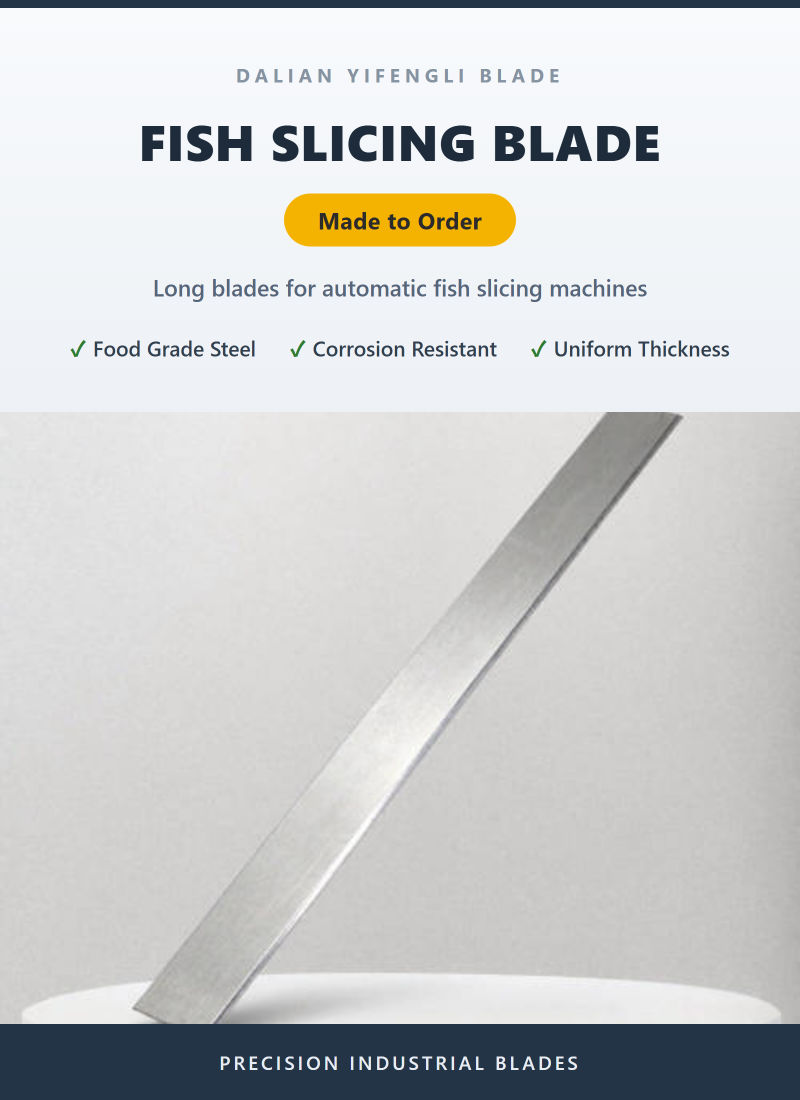
Fish Slicing Blades
Long, ultra-thin slicing blades for automatic fish slicing and portioning machines — made to order in all three directions: the machine, the size and spec, and the steel you need. The thin, honed edge passes through flesh instead of pushing it, so the cut face stays clean and the yield improves. Snakehead, tilapia, basa, salmon, cod, tuna, mackerel — the fish decides the edge, and the edge is set on the drawing.
- Drawing: required for every order (PDF / DWG / sketch) — the drawing governs
- Material: stainless or high-carbon, or the grade you specify — 420J2, 440C, 5Cr15MoV, 9Cr18MoV, or your own spec
- Hardness: HRC 55–60
- Body: ultra-thin and long, plain strip or drilled to your pattern; single-side honed edge
- Size & spec: any length, width and thickness, any mounting — made to your machine, your old blade or your drawing
- Price: quoted per size — one size, one price
- Order size: one piece for a trial, then sets per machine
Tell us the fish and the machine — a blade that slices fresh snakehead will crush a frozen block.
Request a QuoteAny fish — the species sets the blade
We do not build this blade around one fish. In our home market a fish slicing machine is usually set up for snakehead (black fish) — firm, springy flesh, tough skin, cut obliquely into thin fillets for pickled-fish dishes. Export customers cut something else again: tilapia and basa in Africa and South America, salmon and trout in northern Europe, cod and pollock in the North Atlantic, tuna in the Mediterranean and Asia, mackerel and herring in small-portion lines. Firm flesh and soft flesh do not take the same edge, and an oily fish needs a different surface finish from a lean one.
| Fish | What the flesh does to a blade | Steel | Edge |
|---|---|---|---|
| Snakehead (black fish) | Firm, elastic flesh; tough skin; the cut has to shear cleanly or the fillet pulls | 5Cr15MoV or 440C | Fine single bevel, 15–20°, polished flute |
| Tilapia, basa, pangasius | Soft, high water content; a thick bevel drags and tears the cut face | 420J2 or 5Cr15MoV | Very thin bevel, 12–17°, high polish |
| Salmon, trout | Soft, oily; flesh separates if the edge is not sharp along the whole length | 420J2 or 5Cr15MoV | Thin bevel, 15–18°, mirror finish |
| Cod, pollock, hake | Firm white flesh with a soft centre; needs a clean cut line at speed | 5Cr15MoV or 440C | 15–20°, fine honed |
| Tuna | Dense, tough, high load on the edge; loins are also cut partly frozen | 440C or 9Cr18MoV, HRC 56–58 | Stronger bevel, 20–24° |
| Mackerel, herring, sardine | Small, soft, oily; blade runs fast and lightly loaded | 420J2 | Thin bevel, 12–16°, high polish |
| Carp, grass carp | Firm freshwater flesh with fine bones; demands a keen, even edge | 5Cr15MoV or 440C | 15–20°, fine single bevel |
Fresh, frozen, smoked or salted
The state of the fish changes the blade as much as the species does. The same machine that slices fresh fillets in the morning may run frozen blocks in the afternoon, and those are two different blades.
| Product state | What the blade has to do | Edge we recommend |
|---|---|---|
| Fresh / chilled | Pass through soft flesh without dragging or tearing | Thin, finely honed single bevel |
| Frozen blocks | Survive a hard, abrasive product without chipping | Stronger bevel, more body behind the edge |
| Smoked / salted | Resist corrosion and a sticky surface | Stainless, moderately robust edge |
| Portioning / trimming | Hold a constant cut line over a long edge | Fine edge, controlled bevel width, blade held flat |
Made to order — machine, size and steel
Fish blades follow the machine, and the machines are nearly as varied as the plants running them: slicing and portioning stations from a dozen builders, several generations of the same model still in service, and holders that are modified or replaced over the years. Two machines of one model can take different blades. A published size table would be wrong for most inquiries — and worse, it would invite an order for a blade that does not fit.
So we work the other way round: you tell us the machine, we make the size. Length, width, thickness and mounting detail are all set from what your line actually takes — not from the nearest size in a catalogue.
Material is made to order as well. Say stainless and we propose 420J2 or 5Cr15MoV; say “must hold an edge on tuna” and we go to 440C or 9Cr18MoV; say 440C, or a grade from your own drawing, or send a mill certificate from the blade you buy today, and we quote exactly that. If your plant has an approved steel list or a hygiene specification, send it and the quotation is written against it.
| What you fix | What we leave open |
|---|---|
| Machine | Any builder, any generation, any holder — made to the station on your floor |
| Size and spec | Length, width, thickness, edge angle, mounting — all to your drawing or your old blade |
| Material | Stainless, high-carbon, or the exact grade you name — with hardness set to suit the thickness |
| Price | Quoted per size, per steel, per edge — one size, one price |
| Instead of a size list, send us | What we do with it |
|---|---|
| The machine — make, model, station | Match the blade to the holder and the feed of that station |
| The old blade, or its drawing (PDF / DWG / sketch) | Measure and redraw it, then send the drawing back for your approval |
| Photos with a rule in frame — if no drawing exists | Establish length, width, thickness and mounting before quoting |
| The product — species and state | Set the edge angle and the steel grade |
| The quantity — one trial piece or sets per year | Quote per piece and confirm the lead time that applies |
One size, one price
A blade is quoted on the size you actually need, not on the nearest size in a list. The price follows four things: the length, width and thickness of the blade (how much steel, and how much grinding), the steel grade, the edge geometry, and the quantity. That is the whole formula — there is no “non-standard” surcharge, and no premium because a blade happens to be long or thin. Change one dimension and it is a different blade, so it is quoted as one.
For a thin blade, tell us your current breakage rate as well. A very thin body that is being bent in the holder will fail no matter which steel it is made from — worth settling before the size is fixed.
Specifications
| Material options | Stainless steel / high-carbon steel / the grade you specify (420J2, 440C, 5Cr15MoV, 9Cr18MoV, or your own spec and mill certificate) |
| Hardness | HRC 50–60, set by steel grade and blade thickness — thin blades are held lower so they do not chip |
| Blade body | Ultra-thin, long; single-side edge; plain strip or drilled / slotted to your holder |
| Size | Made to your drawing, machine model or old blade — any length (roughly 100–2000 mm), width, thickness and mounting |
| Pricing | Quoted per size and material — one size, one price |
| Edge | Fine-ground single bevel, honed; angle set to the fish and the product state |
| Mounting | To the blade holder or clamp plate of your machine |
| Order size | 1 piece trial, then sets per machine |
Stainless or carbon steel
| Stainless | High-carbon | |
|---|---|---|
| Food contact & wash-down | Default choice; tolerates wet rooms and daily cleaning | Needs a dry line and a fixed cleaning routine |
| Edge | Good, and holds up in corrosive conditions | Finer edge, longer edge life where corrosion is not a factor |
| Salt, brine, smoke | Suitable | Not recommended without strict care |
| Best fit | Wet processing, salted and smoked product, on-board plants | Dry, high-throughput lines cutting fresh fish |
| Grade | Type | Typical use on fish blades |
|---|---|---|
| 420J2 (3Cr13) | Stainless | Soft, oily fish — salmon, trout, mackerel, tilapia. Takes a very thin, highly polished edge |
| 5Cr15MoV | Stainless | The general workhorse for snakehead, carp, basa and white fish; good balance of edge and toughness |
| 440C (9Cr18Mo) | Stainless | Firm, demanding flesh — tuna, snakehead at high volume; higher wear resistance |
| 9Cr18MoV | Stainless | Long runs between changes, partly frozen product |
| High-carbon (65Mn, T8A class) | Carbon | Dry lines, fresh fish only; finest edge, but needs a fixed cleaning routine |
| Your grade | — | Named on your drawing, or matched from a mill certificate of the blade you use now |
Hardness is set with the thickness, not against it: a 0.6–1.0 mm blade above HRC 56 chips instead of wearing, so thin blades are supplied softer than heavy ones. We confirm the grade and the hardness in writing on the quotation, against the fish and the environment you describe. If your plant has a hygiene specification or an approved supplier list, send it and we quote to that.
Why food blades fail early
| What you see | Usual cause | What to do |
|---|---|---|
| Chipped edge on frozen product | Edge ground too thin for frozen blocks, or contact with bone and block edges | Stronger bevel; check the infeed for hard contamination |
| Pitting and staining | Carbon steel in a wet or salty environment | Switch to stainless; rinse and dry between shifts |
| Cut face torn or ragged | Dull edge, or a bevel too thick for the product | Re-specify the edge angle for the product state |
| Blade bent or bowed | Holder out of alignment, or a blade forced past its thickness limit | Check holder and clamp plate; do not increase feed to compensate |
| Edge rolls quickly | Too thin a bevel for the throughput or the product | Increase bevel angle; consider a stronger steel |
The full diagnosis, with the edge angles behind it, is in our guide: fish slicing blade edge angle and steel selection.
What we make — and what we do not
A fish plant buys two very different kinds of blade, and they are not made in the same place. We grind the long, thin, straight blades that slice and portion. We do not make the short blades that sit in automatic filleting, skinning and heading heads.
| Blade | We make it | Note |
|---|---|---|
| Long straight slicing blade, made to your machine | Yes | Thin gauge, extra-long, plain or with the fixing your holder needs |
| Portioning / trimming blade on a long-blade station | Yes | Edge geometry set to the product state |
| Short fillet blade for an automatic filleting or skinning head (the 200 mm class) | No | Different product, different grinding setup. We will tell you so rather than quote something that will not fit |
| Circular, toothed or skinning-roller blades | No | Outside our range |
How an order runs
- You send the machine model, the product you cut and its state, the blade dimensions, and the mounting detail — or the old blade, or photos with a rule in frame.
- We issue a drawing and quotation: steel, hardness, edge geometry, price, lead time.
- You approve the drawing. No steel is cut before that.
- We produce one trial piece or the batch, pack it in a rigid case with the edge protected, and ship with the drawing reference marked on the case.
What to send for a quotation
| Machine | Make and model, and the station the blade runs in (slicing or portioning) |
| Product | Species and state: fresh, chilled, frozen, smoked, salted |
| Blade | Length, width, thickness; edge angle if known |
| Mounting | Holder type, clamp plate, any locating features — photos help |
| Quantity | One trial piece, or sets per machine per year |
| Steel | Your grade if you have one — otherwise we propose it against the fish and the product state |
| Hygiene | Any plant specification or approved-material list |
Frequently asked questions
Do you work from a size list, or is every blade made to order?
Every blade is made to order, and we keep no size list. Fish blades follow the machine, and the machines vary enormously: slicing and portioning stations from different builders, several generations of the same model still in service, and holders that change after a rebuild. Two machines of the same model can take different blades. So we work from your machine, your old blade or your drawing, and produce to that size - length, width and thickness, plus the mounting detail.
How is the price set for a custom size?
Per size. One size, one price: the blade is quoted on the length, width and thickness you actually need, the steel you choose, the edge geometry and the quantity. A longer, wider or thicker blade is a different blade and is quoted separately. There is no surcharge for ordering a non-standard size, and no premium because a blade is long or thin.
Why is the blade ultra-thin and without mounting holes?
A thin, hole-free blade slices with minimal drag and leaves no pocket where product can collect. On food equipment that matters for two reasons: a thinner blade disturbs the flesh less, and a smooth, uninterrupted surface is easier to clean and inspect. The trade-off is that flatness and straightness have to be held during grinding, which is where most of the cost sits.
We cut a different fish from the ones you list - can you still make the blade?
Yes, and that is the normal case for export. Tell us the species, the size of fish, whether it arrives fresh, chilled, frozen, smoked or salted, and the cut you want. Firm flesh such as snakehead or tuna takes a stronger bevel; soft flesh such as tilapia, basa or salmon needs a thinner, more highly polished edge so the cut face does not tear. We propose the steel and the angle, put both on the drawing, and you approve before production.
Can we specify the steel grade ourselves?
Yes. Name the grade - 420J2, 5Cr15MoV, 440C, 9Cr18MoV, a high-carbon grade, or something from your own specification - and we quote that grade. If you send a mill certificate or the data sheet of the blade you buy today, we match it rather than substitute. Hardness is set to suit the thickness: a 0.6-1.0 mm blade is supplied softer than a heavy one, because a thin blade above HRC 56 chips instead of wearing.
Which fish slicing machines does it fit?
Any of them, because the blade is made to order rather than picked from a catalogue — European built slicers, and the Chinese oblique slicers used across Asia, in whatever length and section your machine takes. Send the machine model, or the old blade's length, width, thickness and mounting detail. Photos of the blade in its holder help, because two machines of the same model can differ after a rebuild.
Stainless or carbon steel - which one?
Stainless is the default for food contact and for anything washed down daily, and it is essential where the product is salted, smoked or handled in a wet room. Carbon steel takes a finer, longer-lasting edge and is the choice where the blade runs in a dry, controlled line and is cleaned on a fixed schedule. Tell us the working environment and we confirm the grade on the quotation.
What edge angle should I specify?
It follows the product, not the machine. Fresh and chilled fish takes a thin, finely honed edge. Frozen blocks need a stronger edge because the product is hard and abrasive at temperature. Smoked and salted product needs corrosion resistance first, with a moderately robust edge. We set the angle from the product you cut and state it on the drawing.
Can you supply a full set for one machine?
Yes. Most lines use more than one blade — slicing and portioning blades. Sending the complete list in one enquiry is cheaper than ordering piece by piece, because the blades are made in the same batch and arrive matched.
Do you offer a trial piece before a batch?
Yes. One piece as a trial is normal for a new machine or a new product. Run it, check the cut and the edge life, then order the batch to the same drawing.
How long does delivery take?
Every blade is made to order, so the lead time follows the size, the steel and the quantity - usually two to four weeks, and longer for a large set in a special grade. A trial piece from a new drawing is quoted on the same basis. Blades are packed in a rigid case with the edge protected, and the drawing reference is marked on the case.
Can a used fish blade be reground?
Often yes, if enough body thickness remains and the edge has not been overheated or bent. Send a photo of the edge and the current thickness; we will tell you whether regrinding is worthwhile or whether a replacement is the better spend.
Related reading: Fish slicing blade: edge angle and steel selection · What drives the blade price · How to measure a blade · All technical guides
Running a Chinese oblique slicer or a portioning head? Those machines take a plain thin strip with no holes, and no two builds measure the same — fish slicer blades, made to your measurement →